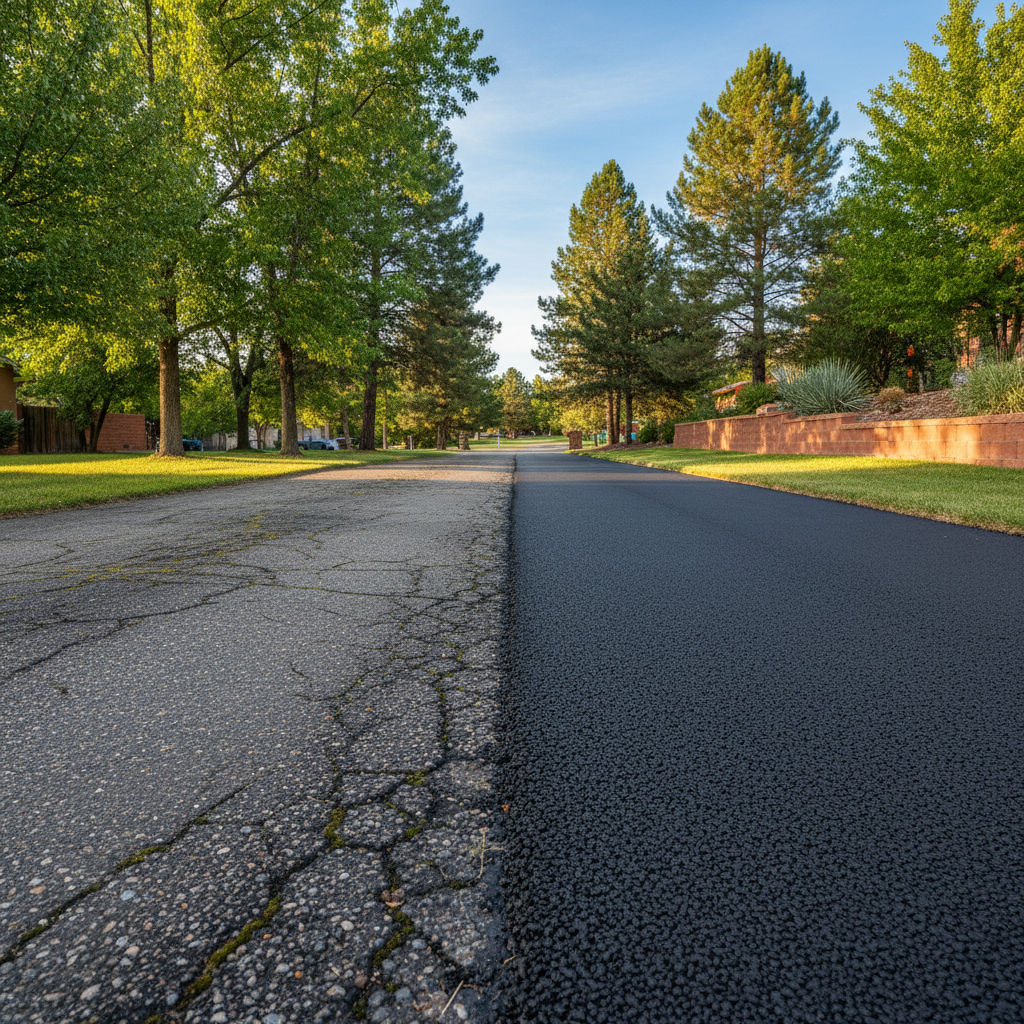
Alright, let's talk driveways. Specifically, what to do when your asphalt is looking rough. Here in Flagstaff, with our crazy freeze-thaw cycles and heavy snow loads, asphalt takes a beating. You might be hearing about "milling" as a solution, but it's not a one-size-fits-all deal. There are a couple of ways to mill, and knowing the difference can save you a headache — and a chunk of change.
I'm going to lay out the two main approaches: Flagstaff Asphalt Construction uses them both, and we see firsthand how they stack up. We're talking about partial-depth milling (which is often followed by an overlay) and full-depth reclamation. Each has its place, depending on what's really going on with your pavement, you know?
Partial-Depth Milling (and Overlay)
This is what most folks think of when they hear "milling." It's like giving your driveway a really good shave. We use a specialized machine, often called a cold planer, to grind off the top layer of asphalt – usually anywhere from 1 to 4 inches deep.
Cost
Generally, partial-depth milling is the more budget-friendly option upfront. You're only removing a portion of the material, so there's less labor and less new asphalt needed for the overlay. The removed material, called Reclaimed Asphalt Pavement (RAP), is often recycled. That helps keep costs down and is good for the environment.
Durability
A partial-depth mill followed by a new asphalt overlay can give your driveway a solid 7-10 years, sometimes more if the underlying base is in good shape. It's great for fixing surface issues like minor cracks, ruts, and unevenness. The key here is that the problems are mostly on the surface. If your base is failing, simply milling the top won't solve the deeper structural issues. Those cracks will likely reflect back through the new surface pretty quickly.
Maintenance
Like any asphalt surface, a milled and overlaid driveway benefits from regular maintenance. That means sealcoating every 3-5 years to protect it from our intense Flagstaff sun and winter elements. Good drainage is also crucial; we always make sure to re-establish proper slopes during the milling process to prevent water pooling. That's a big deal with our monsoon rains and snowmelt.
Appearance
After a new overlay, your driveway will look brand new – smooth, black, and sharp. It's a significant aesthetic upgrade, getting rid of all those ugly surface imperfections.
Full-Depth Reclamation (FDR)
Now, if your driveway looks like a spiderweb of cracks, has significant potholes, or feels like a roller coaster ride because the base is shot, partial milling won't cut it. That's when we look at full-depth reclamation. This isn't just a surface fix; it's a complete rebuild from the ground up, right there on site.
Cost
FDR is a bigger investment upfront than partial milling. You're essentially rebuilding the entire pavement structure. However, it's usually faster and less expensive than a full "dig out and replace" job because we're recycling all the existing material in place. Over the long haul, FDR can actually be more cost-effective. It provides a much more durable, longer-lasting solution, reducing the need for frequent repairs.
Durability
This is where FDR shines. We pulverize the entire asphalt layer and a portion of the underlying base, then mix it all with stabilizing agents. This creates an incredibly strong, stable new base for your asphalt. It addresses the root cause of pavement failure, like an unstable sub-base, which is common in areas with our volcanic soils or expansive clays, for example, in parts of Cheshire. An FDR project can easily last 15-20 years or more, often outperforming new asphalt laid over an unaddressed weak base.
Maintenance
Because FDR creates such a robust foundation, the maintenance needs are typically lower over its lifespan compared to a surface-only repair. You'll still want to keep up with sealcoating to protect the surface from UV and moisture, but you're less likely to see structural issues pop up.
Appearance
Just like with partial milling, the final step in FDR is laying down a fresh asphalt surface. So, the end result is a smooth, beautiful, and brand-new looking driveway. The big difference is that this new surface is sitting on a rock-solid foundation that's built to last.
My Recommendation for Flagstaff Homeowners
Here's the deal: for us in Flagstaff, our climate is tough on pavement. Those extreme temperature swings, heavy snow, and freeze-thaw cycles really put stress on asphalt. If your driveway has minor surface cracks, some shallow rutting, or just looks faded and worn, then partial-depth milling and an overlay is a fantastic, cost-effective solution. It'll give you a great-looking, durable surface for years.
But if you're seeing widespread alligator cracking, deep potholes, areas that constantly sink or hold water, or if your driveway has been patched repeatedly and those patches keep failing, then you've got deeper problems. In these cases, I strongly recommend full-depth reclamation. It's the honest way to fix the problem permanently. You're addressing the underlying issues that our Flagstaff weather exacerbates, rather than just putting a band-aid on the surface. It's a bigger investment initially, sure, but it will save you money and headaches in the long run by giving you a pavement that truly holds up to Northern Arizona conditions.
No matter which route you're leaning towards, the first step is always to get a professional assessment. We'll take a look, figure out what's really going on beneath the surface, and give you an honest recommendation. Give us a call at Flagstaff Asphalt Construction, and we'll help you get that driveway sorted.